
Fluorescent Halogen Bonding Arylethynyl Scaffolds For Anion Recognition
Lead inventor: Darren Johnson
Co-inventors: Michael Haley, Jessica Lohrman
Licensing contact: Elliot Reed
1. Technology Overview
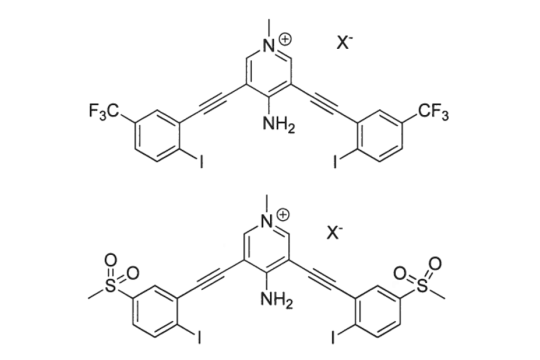
The invention focuses on fluorescent halogen bonding arylethynyl scaffolds for anion recognition. These scaffolds utilize neutral para-positioned electron withdrawing groups to polarize halogen bond donating groups within the arylethynyl structure, enabling reversible anion binding in solution with a spectroscopic response upon binding. The technology is currently in the development stage, with promising cross-industry applications in agricultural, biomedical, and environmental monitoring.
2. Key Features and Benefits
- Halogen bond polarization: Enhances anion recognition capabilities.
- Reversible anion binding: Provides reliable detection in solution.
- Spectroscopic response: Enables optical detection of anion binding.
- Versatility: Applicable to various industries, including agriculture and biomedicine.
- Scalability: Synthesis processes can be scaled for larger quantities.
3. Applications & Market Focus
- Agriculture: Use in soil and water anion analysis.
- Biomedicine: Integration into biological anion detection systems.
- Environmental monitoring: Development of novel anion sensing methods.
- Chemical industry: Synthesis of complex organic molecules for various applications.
- Advanced sensing technologies: Use in emerging anion recognition systems.
4. Commercial Advantages
- Strategic benefits: Provides reliable and scalable anion recognition scaffolds for various applications.
- Implementation advantages: Facilitates integration into existing anion sensing systems.
- Market positioning: Positions technology as a key enabler for advanced anion recognition methods.
- Competitive advantages: Offers halogen bond polarization and spectroscopic response compared to existing methods.
5. Partnership Opportunities
- Ideal licensing partners: Agricultural firms, biomedical companies, environmental monitoring organizations.
- Cross-sector partnership benefits: Collaboration opportunities across agriculture, biomedicine, and environmental monitoring industries.
- Diverse market opportunities: Potential for global market expansion in regions with strong agricultural and biomedical industries.
- Collaborative development: Opportunities for joint development of hybrid devices and custom synthesis services.
Patent filing: US11021447B2