
Catalysis Inside of Radially-Oriented p-Systems
Lead inventor: Ramesh Jasti
Co-inventors: Jeff Van Raden
Licensing contact: Christine Gramer
1. Technology Overview
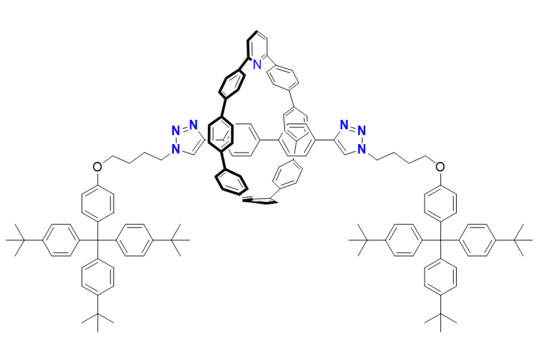
The invention focuses on catalysis inside radially-oriented T-systems using cycloparaphenylenes (CPPs), the smallest fragment of armchair carbon nanotubes (CNTs). These CPPs are synthesized with atomistic precision, incorporating meta-substituted pyridine units to position metals inside the hoop, enabling catalysis within these nanohoop architectures. The technology is currently in the development stage, with promising cross-industry applications in nanotechnology, materials science, and chemical synthesis.
2. Key Features and Benefits
- Atomistic precision: Provides efficient synthesis of nanohoop architectures.
- Unique electronic environment: Facilitates various chemical reactions inside the nanohoop.
- Versatility: Applicable to various industries, including nanotechnology and materials science.
- Scalability: Synthesis processes can be scaled for larger quantities.
- Catalytic applications: Ideal for advanced catalytic processes and molecular shuttling.
3. Applications and Market Focus
- Nanotechnology: Use in catalysis within nanostructures.
- Materials science: Development of novel catalytic materials.
- Chemical industry: Synthesis of complex organic molecules for various applications.
- Advanced catalytic processes: Use in emerging nanotechnology applications.
- Polymerizations and sensing: Integration into polymerization processes and sensing technologies.
4. Commercial Advantages
- Strategic benefits: Provides reliable and scalable nanohoop architectures for various applications.
- Implementation advantages: Facilitates integration into existing catalytic and nanotechnology systems.
- Market positioning: Positions technology as a key enabler for advanced catalytic processes.
- Competitive advantages: Offers atomistic precision and unique electronic environment compared to existing methods.
5. Partnership Opportunities
- Ideal licensing partners: Nanotechnology firms, materials science companies, chemical industry leaders.
- Cross-sector partnership benefits: Collaboration opportunities across nanotechnology and materials science industries.
- Diverse market opportunities: Potential for global market expansion in regions with strong nanotechnology and materials science industries.
- Collaborative development: Opportunities for joint development of hybrid devices and custom synthesis services.
Patent filing: US11142500B2