
Donor/Acceptor Nanohoops
Lead inventor: Ramesh Jasti
Co-inventors: Evan Darzi
Licensing contact: Christine Gramer
1. Technology Overview
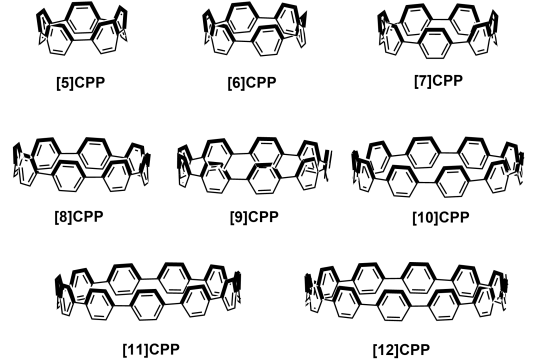
The invention focuses on donor/acceptor nanohoops, which are novel, conjugated, hoop-shaped molecules designed for organic semiconducting materials. These nanohoops incorporate electron-donating and electron-accepting molecules into their structure, allowing for easy tuning of band gaps. The technology is currently in the development stage, with promising cross-industry applications in organic electronics, sensing technologies, and material science.
2. Key Features and Benefits
- Enhanced solubility: Provides better solubility compared to linear polymer materials.
- Shape-persistent pores: Enables sensing or doping applications.
- Long-range pores: Maintains good pi-pi contact for electronic communication in the solid state.
- Tunable band gaps: Allows for easy adjustment of HOMO-LUMO energy levels.
- Versatility: Applicable to various industries, including organic electronics and sensing technologies.
3. Applications and Market Focus
- Organic electronics: Use in developing semiconducting materials.
- Sensing technologies: Integration into sensing applications.
- Material science: Development of novel nanostructures.
- Advanced semiconducting materials: Use in emerging organic electronics applications.
- Chemical industry: Exploitation of donor/acceptor nanohoops for various applications.
4. Commercial Advantages
- Strategic benefits: Provides reliable and scalable donor/acceptor nanohoops for various applications.
- Implementation advantages: Facilitates integration into existing organic electronics and sensing systems.
- Market positioning: Positions technology as a key enabler for advanced semiconducting materials.
- Competitive advantages: Offers enhanced solubility, shape-persistent pores, and tunable band gaps compared to existing methods.
5. Partnership Opportunities
- Ideal licensing partners: Organic electronics manufacturers, sensing technology firms, material science companies.
- Cross-sector partnership benefits: Collaboration opportunities across organic electronics, sensing technologies, and material science industries.
- Diverse market opportunities: Potential for global market expansion in regions with strong organic electronics and sensing technologies industries.
- Collaborative development: Opportunities for joint development of hybrid devices and custom synthesis services.
Patent filing: US10934290B2